




When leaving a job, people often ask, “What happens to my 401k?” or “Will I lose any of my employer’s matching contributions?” The choices you make can affect your retirement savings. Depending on how you move or withdraw the money, you could face tax withholding, income taxes, or an early withdrawal penalty. This blog explains your options so you can make an informed decision about your 401(k) when you leave a job.
What is a 401(k)?
A 401(k) is one of the most common retirement plans. It is an employer-sponsored retirement savings plan. It lets employees invest a portion of their paycheck in a tax-advantaged account. Depending on the plan, contributions are made before taxes (traditional) or after taxes (Roth).
Employers may also offer matching contributions, but you may need to work there for a certain period before that money is fully yours. This is called vesting. Before leaving your job, check with your plan administrator to find out how much of your employer’s contributions you can keep.

1. Leave your money in your former employer’s plan, if allowed.
Some employers allow you to keep your 401(k) in their plan, but you cannot make contributions. However, if your vested balance is below the plan’s cash-out limit (which can be up to $7,000), your former employer may move it out of the plan without your consent. What happens next depends on the amount:
-
$1,000 or less: the plan may send you a check.
-
More than $1,000: the plan must roll the money into an IRA in your name, unless you choose another option.
Check with your plan administrator to see if there may be any applicable cash-out limits.
2. Roll over your money to your new employer’s 401(k) plan.
This option moves your money directly into your new employer’s plan, as long as the new plan accepts incoming rollovers. Check the plan’s investment options, fees, and rules before deciding.
3. Cash out and keep the money.
If you would like to access the money now, you can cash out. However, this option may come with taxes and penalties. For a typical lump-sum cash-out, the plan withholds 20% of the taxable amount for federal income tax. This is a tax prepayment, and your final tax bill may be higher or lower. If you are under 59½, you may also owe a 10% early withdrawal penalty unless an exception applies.
If you change your mind, you have 60 days to roll the money into another retirement account. To roll over the full amount, you must replace the 20% that was withheld with your own funds.
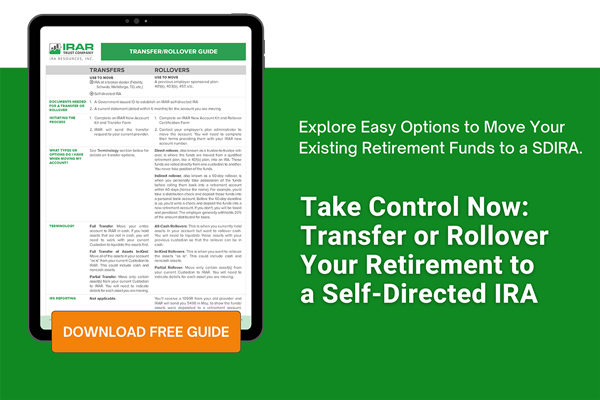
4. You can choose to roll over your money into an SDIRA.
You can roll over your 401(k) into a Self-Directed IRA to invest in alternative assets, such as real estate. A rollover from a pre-tax 401(k) into a traditional SDIRA is not taxed when you move it. Rolling pre-tax money into a Roth SDIRA is a taxable conversion.
What is a Self-Directed IRA?
A Self-Directed IRA (SDIRA) is a retirement account that allows investors to hold assets beyond stocks, bonds, and other common investments. It follows the same basic tax rules as an IRA held by a brokerage. The difference is the custodian. A custodian that supports alternative assets lets you hold many types of them.
Common self-directed IRA investment options include:
-
Real estate, including residential, commercial, multifamily, and vacant land
-
Real estate notes and deeds of trust
-
Private lending, private placements, and real estate syndications
-
LLCs and partnerships
-
Tax liens and tax deeds and much more!
You are not limited to just stocks and mutual funds. Simply put, if you are looking for a way to build up your portfolio with more than just stocks, then an SDIRA could be the answer.
Keep in mind that IRS rules still apply. Some investments can create unrelated business income tax (UBIT). Prohibited transaction rules also limit who you can do business with.
How to roll over a 401(k) after leaving a job
First open an account with the custodian you choose. Then, contact your old 401(k) provider or administrator and request a direct rollover. Provide your new IRA account details so they know where to send the money. A direct rollover sends the money from one account to the other, so the 20% withholding does not apply.
Why Choose IRAR as Your Self-Directed IRA Custodian?
IRAR makes it easy to roll over your former employer’s 401(k) into a Self-Directed IRA. Our Transfer and Rollover Assistant helps you identify the right process, open your account, and follow the steps to move your funds. Our team is here to answer any questions along the way.
As your custodian, IRAR helps process investment transactions, maintain account records, and report to the IRS, as required by law. Ready to explore your options? Schedule your free consultation with an IRAR specialist to walk through how to use your retirement account for a real estate investment or other alternative assets.






Comments (0)